Articles Tagged with charlotte dwi lawyer

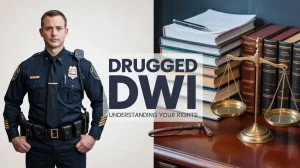
Drug-based DWI prosecutions in North Carolina operate under an evidentiary framework that differs substantially from alcohol enforcement. In DUI cases involving drugsDrug DWI in North Carolina graphic showing police officer beside law books, courtroom scales, and gavel representing drugged driving charges (sometimes called DUID – driving under the influence of drugs) or “drugged driving” by the general public, the forensic analysis and legal issues tend to be significantly more complex.  
Unlike alcohol, for which decades of research have provided relatively clear thresholds (like 0.08 BAC) and relatively well-understood pharmacology, psychoactive drugs present a diverse and evolving challenge. 

Alcohol impairment is supported by decades of controlled laboratory research, standardized psychomotor testing models, and population-level epidemiology that correlate rising blood alcohol concentrations with relatively predictable losses of cognitive and motor functioning at certain BAC levels.

The Limits of Chemical Certainty: The Auto-Brewery Syndrome & DWI Charges 

Auto-Brewery Syndrome (ABS) remains a bit of a theoretical curiosity. It represents a measurable biochemical anomaly during which yeast or bacteria residing in the gastrointestinal tract convert carbohydrates into ethanol within the human body. North Carolina judge in a courtroom setting representing judicial evaluation of scientific evidence and credibility in DWI cases involving Auto-Brewery Syndrome

Though somewhat rare, it is medically documented, scientifically verifiable in some instances, and possibly legally consequential, at  least relative to DUI charges in North Carolina. 

North Carolina Law Talk – Summer 2016

Attorneys Mike Daisley and Bill Powers discuss developing trends and provide legal commentary on North Carolina Law issues.  If you have general questions about how the legal system works in North Carolina, please feel free to contact Mike and Bill at:

Mike Daisley:

How Long Can a Case Be Continued for Lab Reports? How is Blood Evidence Proven in Court? How Long Does It Take to Get Blood Results?

Blood Testing in DWI cases takes time and involves a delicate balance of trial schedules, witness availability, and scientific testing protocols – Bill Powers 

What is Chain of Custody?

Modified Transcript of “Can you be convicted of dui without alcohol in your system in north carolina” for the Hearing Impaired:

So often times, when we think about the culture of driving while impaired, in other states driving under the influence or driving while intoxicated, it always has this connotation of being alcohol related, and that is no longer the case.

Frankly, it’s never been completely the case, but the incidence of non-alcohol related impaired driving over the last, I’ll say 5, 6, 7 years, has changed the complete landscape as to how we deal with these, and what law enforcement officers look for when prosecuting people.

Modified Transcript of “DWI Other Than Alcohol” for the Hearing Impaired:

If you are behind the wheel, if something is negatively affecting your ability to operate a motor vehicle, that could make you liable for driving while impaired.

Chris McCartan discusses Impairment and DWI with substances other than alcohol in North Carolina.

11 arrested in Charlotte DWI Checkpoint 022315

LEGAL REFERENCE MATERIALS  – Tracking Checkpoint Locations 2015 Charlotte-Metro Region –
Charlotte DWI Checkpoint 022315 at 5th Street and N. Caldwell Street resulted in 11 motorists being arrested for Driving While Impaired.

DWI Checkpoints must be fairly and evenly enforced.  Bill Powers

See Related for Charlotte DWI DUI Checkpoints: NCGS 20-16.3 CHECKPOINTS

Charlotte DWI DUI Checkpoints are authorized by the North Carolina General Assembly in N.C.G.S. § 20-16.3A.

“Probable cause for an arrest has been defined to be a reasonable ground of suspicion supported by circumstances sufficiently strong in themselves to warrant a cautious man in believing the accused to be guilty…. To establish probable cause the evidence need not amount to proof of guilt, or even to prima facie evidence of guilt, but it must be such as would actuate a reasonable man acting in good faith.” 5 Am.Jur.2d, Arrest § 44 (1962); State v. Harris, 279 N.C. 307, 182 S.E.2d 364 (1971).

Probable Cause Hearings in North Carolina

Modified Transcript of “Probable Cause to Arrest DWI” for Hearing Impaired:

Contact Information