Articles Posted in DUI

Blood testing is often viewed as the most dependable way to measure alcohol concentration in a North Carolina DWI case. The scienceDWI blood testing illustration with a Charlotte police officer, North Carolina map, legal books, scales of justice, and paperwork emphasizing rights in a North Carolina DWI case behind BAC tests is powerful, but it is also technical, layered with protocols, human decision points, and laboratory processes that must be followed with precision. When a “drunk driving” case shifts from the roadside to the laboratory, the entire conversation changes. You move from dexterity exercises to molecular chemistry, and from visible performance to physics, gas chromatography and mass spectroscopy, both topics that an average juror would never see unless brought to life at trial by defense counsel.

DWI defense lawyer Bill Powers has spent more than thirty years watching how blood testing evidence develops in courtrooms across Mecklenburg County and throughout North Carolina. During that time, he has cross examined toxicologists, reviewed extensive laboratory documentation, and taught officers and lawyers about breath and blood science, standardized field sobriety tests, and trial strategies and protocols. His experience includes the practical knowledge of how jurors interpret toxicology evidence and how those interpretations can shift once they hear how the underlying science actually works.

If you are dealing with a DWI charge that involves blood testing, or if you are a lawyer looking to sharpen your trial approach to forensic toxicology, please contact the DWI defense lawyers at Powers Law Firm in Charlotte. Call or TEXT 704-342-4357 to discuss how careful preparation and scientific clarity can shape the outcome of a case.

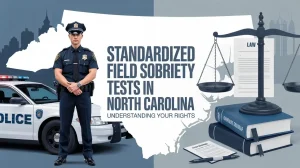
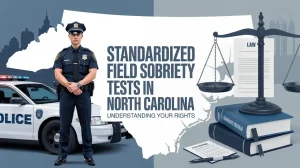
This post continues the Breath, Blood, and Bull series, an in-depth look at how science, procedure, and perception collide in the North Carolina standardized field sobriety tests illustration with police officer patrol car law books and scales of justice for DWI rights education prosecution and defense of DWI cases in North Carolina. The first installment examined the limits of chemical testing. The second article turned to the machines that interpret alcohol breath samples into evidence, using the “breathalyzer.” This post focuses on the field sobriety tests or “SFSTs” that often precede BAC testing.

Standardized Field Sobriety Tests (SFSTs) are a battery of three roadside exercises: Horizontal Gaze Nystagmus (HGN), Walk-and-Turn (WAT), and One-Leg Stand (OLS), designed by NHTSA to gauge impairment.

When prosecutors rely on Standardized Field Sobriety Tests to support a DWI charge, the assumption is that these dexterity exercises offer reliable, objective proof of impairment. Yet the science tells a more complicated story.

The Limits of Chemical Certainty: The Auto-Brewery Syndrome & DWI Charges 

Auto-Brewery Syndrome (ABS) remains a bit of a theoretical curiosity. It represents a measurable biochemical anomaly during which yeast or bacteria residing in the gastrointestinal tract convert carbohydrates into ethanol within the human body. North Carolina judge in a courtroom setting representing judicial evaluation of scientific evidence and credibility in DWI cases involving Auto-Brewery Syndrome

Though somewhat rare, it is medically documented, scientifically verifiable in some instances, and possibly legally consequential, at  least relative to DUI charges in North Carolina. 

TL;DR Quick Take: The legacy of North Carolina v. Rogers reaches beyond suppression hearings. It redefines how courts balance Founding-era statesmen drafting a constitution in a historic law library with quill pens and parchment, symbolizing the creation of the North Carolina State Constitution and early American constitutional law government trust against the structural necessity of constitutional discipline. Whether this evolution strengthens justice or weakens liberty depends on how future courts interpret the limits of “reasonableness” in applying the Good Faith Exception to the Exclusionary Rule.

I. Constitutional Remedies and the Philosophy of Enforcement

Constitutional rights mean little without remedies that make them enforceable. The framers of the US Constitution understood this when they created mechanisms to restrain power through process.

This post continues the Breath, Blood, and Bull series, which explores how science, technology, and human judgment shape DWI Police officer speaking with a driver during a traffic stop, illustrating field sobriety and breath testing procedures in North Carolina DWI investigations enforcement in North Carolina.

The first article examined the limits of field sobriety testing. This installment turns to the machines that translate breath into evidence, using “breathalyzers.”

By unpacking how they measure alcohol, where they can fail, and how lawyers challenge their results, you’ll see why science is not necessarily as simple as a number on a printout.

TL;DR Quick Take: North Carolina v. Rogers could prove to be one of the most consequential constitutional rulings in North Carolina criminal A senior North Carolina judge sits in a historic courtroom, wearing a black judicial robe and gazing forward with a thoughtful, serious expression. Sunlight filters through tall arched windows, reflecting the dignity and gravity of constitutional decision-making in North Carolina’s courts law in decades. The opinion not only interprets N.C.G.S. § 15A-974 but also redefines how North Carolina courts understand the relationship between the Fourth Amendment and Article I, Section 20 of the North Carolina State Constitution.

As applied, the Good Faith Exception articulated in State v. Rogers reverses longstanding precedent set forth in North Carolina v. Carter

The burden quietly shifts to the accused to demonstrate unreasonableness, reversing long-standing Due Process protections and draining both the fruit and the fiber from the “poisonous tree.”

The Supreme Court of North Carolina’s opinion in North Carolina v. Rogers (Oct. 17, 2025) deserves careful study by Police officer standing beside a stopped car in North Carolina at dusk, representing the good faith exception to the exclusionary rule and Fourth Amendment search and seizure law. criminal defense and DUI defense lawyers.

TL;DR Quick Take North Carolina v. Rogers reshapes how certain suppression motions may be litigated in North Carolina. The Supreme Court interpreted the 2011 “good faith” amendment to N.C.G.S. §15A-974 as significantly limiting the scope of the exclusionary rule, allowing evidence obtained through unlawful searches to be admitted if officers relied on objectively reasonable belief in the legality of their conduct. The decision narrows the path for defendants seeking suppression and marks a turning point in how trial courts evaluate Fourth Amendment violations.

Editor’s Note: The Supreme Court’s decision in State v. Rogers addressed good-faith reliance on a judicial order, not warrantless arrests or searches. The opinion leaves open whether the same reasoning will apply to warrantless seizures or probable-cause challenges. For now, Rogers appears to narrow the exclusionary rule only in the context of judicially authorized warrants and orders.

Accessing video evidence, body-cam, and dash-cam video in North Carolina potentially just became a lot harder to obtain. CMPD police officer’s uniform with a body-worn camera attached to the vest. The blurred city of Charlotte skyline in the background suggests an urban Mecklenburg County, North Carolina setting, representing law enforcement video evidence and accountability.

TL;DR Quick Take: North Carolina v. Chemuti limits how defendants can access police body-worn and dash-camera recordings. The Supreme Court held that Rule 45 subpoenas cannot compel production of law-enforcement video. Instead, defendants must file a petition under N.C.G.S. § 132-1.4A in superior court, which is the exclusive procedure for release.

The Chemuti ruling is significant because, unlike many states, North Carolina provides no traditional right to discovery in cases originating in district court.

For more than three decades, I have worked in North Carolina courtrooms handling DUI cases where law, science, and technology collide. Police officer standing beside patrol car with flashing lights during a traffic stop in North Carolina Few areas highlight that collision more than impaired driving prosecutions involving fatalities and serious injuries.

When an officer testifies about roadside tests or a LCA – Licensed Chemical Analyst explains “breathalyzer” machine results, the evidence is often presented with the weight of scientific certainty. But those of us who defend DWI charges know that level of certitude is sometimes a bit overstated.

The reality is that DUI cases are a perfect storm of pharmocokenetics, engineering, and criminal procedure.

DRE testimony has become a fixture in North Carolina’s most serious impaired driving cases, including felony death by vehicle and Police officer in courtroom testifying about drug recognition expert (DRE) testimony in North Carolina impaired driving case second-degree murder charges.

The Court of Appeals’ July 2025 opinion in North Carolina v. Moore provides essential guidance for lawyers, judges, and anyone facing charges based on drug impairment evidence. Understanding how DRE testimony is used, challenged, and scrutinized at trial can mean the difference between conviction and acquittal, and may shape plea negotiations and appellate strategy.

When legal charges involve both scientific analysis and complex courtroom questions, DRE testimony can have a significant impact on the outcome. At Powers Law Firm, clients facing felony death by vehicle, felony serious injury by vehicle, misdemeanor death by vehicle, and impaired driving charges trust our experience with serious criminal charges in Mecklenburg, Iredell, Union, Gaston, Lincoln, Rowan, and Stanly Counties. We review select cases across North Carolina. If your case hinges on technical or scientific evidence involving DRE testimony or allegations of drug impairment, please can TEXT or call 704-342-4357 to schedule a confidential consultation.

Contact Information