Articles Posted in DWI

Blood testing is often viewed as the most dependable way to measure alcohol concentration in a North Carolina DWI case. The scienceDWI blood testing illustration with a Charlotte police officer, North Carolina map, legal books, scales of justice, and paperwork emphasizing rights in a North Carolina DWI case behind BAC tests is powerful, but it is also technical, layered with protocols, human decision points, and laboratory processes that must be followed with precision. When a “drunk driving” case shifts from the roadside to the laboratory, the entire conversation changes. You move from dexterity exercises to molecular chemistry, and from visible performance to physics, gas chromatography and mass spectroscopy, both topics that an average juror would never see unless brought to life at trial by defense counsel.

DWI defense lawyer Bill Powers has spent more than thirty years watching how blood testing evidence develops in courtrooms across Mecklenburg County and throughout North Carolina. During that time, he has cross examined toxicologists, reviewed extensive laboratory documentation, and taught officers and lawyers about breath and blood science, standardized field sobriety tests, and trial strategies and protocols. His experience includes the practical knowledge of how jurors interpret toxicology evidence and how those interpretations can shift once they hear how the underlying science actually works.

If you are dealing with a DWI charge that involves blood testing, or if you are a lawyer looking to sharpen your trial approach to forensic toxicology, please contact the DWI defense lawyers at Powers Law Firm in Charlotte. Call or TEXT 704-342-4357 to discuss how careful preparation and scientific clarity can shape the outcome of a case.

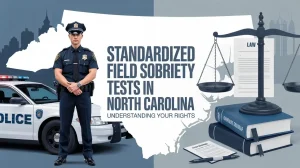
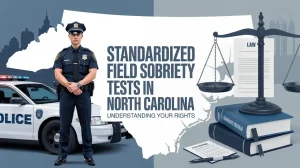
This post continues the Breath, Blood, and Bull series, an in-depth look at how science, procedure, and perception collide in the North Carolina standardized field sobriety tests illustration with police officer patrol car law books and scales of justice for DWI rights education prosecution and defense of DWI cases in North Carolina. The first installment examined the limits of chemical testing. The second article turned to the machines that interpret alcohol breath samples into evidence, using the “breathalyzer.” This post focuses on the field sobriety tests or “SFSTs” that often precede BAC testing.


Standardized Field Sobriety Tests (SFSTs) are a battery of three roadside exercises: Horizontal Gaze Nystagmus (HGN), Walk-and-Turn (WAT), and One-Leg Stand (OLS), designed by NHTSA to gauge impairment.

When prosecutors rely on Standardized Field Sobriety Tests to support a DWI charge, the assumption is that these dexterity exercises offer reliable, objective proof of impairment. Yet the science tells a more complicated story.

The Limits of Chemical Certainty: The Auto-Brewery Syndrome & DWI Charges 

Auto-Brewery Syndrome (ABS) remains a bit of a theoretical curiosity. It represents a measurable biochemical anomaly during which yeast or bacteria residing in the gastrointestinal tract convert carbohydrates into ethanol within the human body. North Carolina judge in a courtroom setting representing judicial evaluation of scientific evidence and credibility in DWI cases involving Auto-Brewery Syndrome

Though somewhat rare, it is medically documented, scientifically verifiable in some instances, and possibly legally consequential, at  least relative to DUI charges in North Carolina. 

TL;DR Quick Take: The legacy of North Carolina v. Rogers reaches beyond suppression hearings. It redefines how courts balance Founding-era statesmen drafting a constitution in a historic law library with quill pens and parchment, symbolizing the creation of the North Carolina State Constitution and early American constitutional law government trust against the structural necessity of constitutional discipline. Whether this evolution strengthens justice or weakens liberty depends on how future courts interpret the limits of “reasonableness” in applying the Good Faith Exception to the Exclusionary Rule.

I. Constitutional Remedies and the Philosophy of Enforcement

Constitutional rights mean little without remedies that make them enforceable. The framers of the US Constitution understood this when they created mechanisms to restrain power through process.

For more than three decades, I have worked in North Carolina courtrooms handling DUI cases where law, science, and technology collide. Police officer standing beside patrol car with flashing lights during a traffic stop in North Carolina Few areas highlight that collision more than impaired driving prosecutions involving fatalities and serious injuries.

When an officer testifies about roadside tests or a LCA – Licensed Chemical Analyst explains “breathalyzer” machine results, the evidence is often presented with the weight of scientific certainty. But those of us who defend DWI charges know that level of certitude is sometimes a bit overstated.

The reality is that DUI cases are a perfect storm of pharmocokenetics, engineering, and criminal procedure.

In North Carolina, some people refer to the Alco Sensor FST as the “breathalyzer” or “PBT” (portable breath test). It is is a handheld breath alcohol screening device used by law North Carolina police officer conducts roadside sobriety test before breathalyzer PBT in DWI investigation enforcement on scene to confirm the consumption of alcohol.  If you’ve been charged with driving while impaired, it’s a legitimate question to ask: Is the breathalyzer on the side of the road reliable?

Both the Alco Sensor FST and the EC/IR II (products of the Intoximeters corporation) detect the presence of ethyl alcohol (ethanol) in breath using an electrochemical fuel cell. Under N.C.G.S. 20-16.3, the Alco Sensor FST is approved for roadside screening. A positive or negative indication for alcohol may be considered when determining whether there is probable cause to arrest.

The numerical result of the AlcoSensor FST is generally not admissible to prove a violation of N.C.G.S. 20-138.1. A numeric portable breath test value may appear in limited administrative proceedings, but it is generally not used to establish the elements of the prima facie elements of the criminal offense of driving while impaired in North Carolina.

Cortisol, often referred to as the primary stress hormone, is produced by your adrenal glands in response to stressful situations, including anxiety-provoking encounters CORTISOL-STRESS-AND-BAC-BREATH-TESTS-IN-NC such as traffic stops, arrests, and DWI charges.

Cortisol plays an important role in regulating energy by promoting gluconeogenesis, the production of glucose from non-carbohydrate sources, and mobilizing glycogen stores.

During acute stress, elevated cortisol levels help ensure that your body has enough energy to manage the perceived threat.

You may not expect prescription medication to expose you to DUI charges. Yet in North Carolina, impairment rather than the legality of the substance or intent to break the law triggers criminal charges. If a prescribed medication impairs your ability to drive, you can be prosecuted under state law. That surprises some folks, who mistakenly believe following “doctor’s orders” and driving is OK.

How North Carolina Defines Prescription Medication DUI

Under N.C. Gen. Stat. § 20-138.1, someone commits the offense of impaired driving if they operate a vehicle while with a blood alcohol concentration of 0.08 or more or under the influence of an impairing substance, even if the substance is prescribed. The statute essentially bars the defense that a drug was legally prescribed if taking the medication adversely affects your mental or physical faculties to such extent there is a noticeable or appreciable impairment.

If you’re facing charges in North Carolina, there’s a good chance your case will not be resolved on the first court date, and therefore, CASE-CONTINUANCE-NORTH-CAROLINA-COURT-CALENDAR you will need a continuance. It might be continued again, and again after that. Whether you’re charged with DWI in Mecklenburg County or facing a felony in Union County, continuances are part of the system.

Some clients ask, “Why is my case taking so long?” not realizing that continuances often help the defense more than they help the State. They wonder if the judge is overlooking something or if the system just doesn’t care. Some assume a continuance means something is wrong. In reality, it’s usually the opposite.

In criminal and DWI courtrooms across North Carolina, continuances are rarely about delay for its own sake. They result from crowded dockets, incomplete discovery, unavailable officers or witnesses, scheduling conflicts, or system failures that no one in the courtroom controls.

Should Eyelid Tremor Be Used to Prove Cannabis Impairment in North Carolina?

Drug-Impaired-Driving-Evidence-North-Carolina EYELID TREMOR

For years, the Drug Recognition Evaluator (DRE) protocol has relied on a structured set of physical observations to evaluate suspected drug impairment. Among these, the presence of eyelid tremor has been taught as a supposed sign of recent cannabis use. In practice, that means law enforcement officers conducting roadside evaluations or testifying in court may point to an eyelid tremor as evidence supporting probable cause or impairment. But as a recent study published in Clinical Toxicology makes clear, the scientific foundation for this assumption is, at best, unproven. At worst, it is affirmatively misleading.

In a 2024 peer-reviewed clinical research article by George Sam Wang and colleagues, the authors conducted a carefully controlled, blinded study to evaluate whether eyelid tremor could reliably and accurately be identified as a marker of recent cannabis use. The conclusion was clear. Eyelid tremor does not correlate with cannabis ingestion in a scientifically defensible way. Inter-rater reliability was poor to moderate. Specificity was dismal. And perhaps most importantly for DWI defense lawyers, the entire protocol used by officers to “spot” this supposed indicator would not come close to passing scientific muster in any peer-reviewed laboratory setting.

Contact Information