Articles Tagged with Due Process

TL;DR Quick Take: North Carolina v. Rogers could prove to be one of the most consequential constitutional rulings in North Carolina criminal A senior North Carolina judge sits in a historic courtroom, wearing a black judicial robe and gazing forward with a thoughtful, serious expression. Sunlight filters through tall arched windows, reflecting the dignity and gravity of constitutional decision-making in North Carolina’s courts law in decades. The opinion not only interprets N.C.G.S. § 15A-974 but also redefines how North Carolina courts understand the relationship between the Fourth Amendment and Article I, Section 20 of the North Carolina State Constitution.

As applied, the Good Faith Exception articulated in State v. Rogers reverses longstanding precedent set forth in North Carolina v. Carter

The burden quietly shifts to the accused to demonstrate unreasonableness, reversing long-standing Due Process protections and draining both the fruit and the fiber from the “poisonous tree.”

Judicial independence is one of the defining principles of American government. It protects the courts from political retaliation, Judge seated at a courtroom bench wearing a black robe, symbolizing judicial independence, fairness, and impartiality in North Carolina’s court system. intimidation, and coercion, allowing judges to apply the law faithfully rather than bending to public opinion or private pressure.
Without judicial independence, due process would be hollow, and the rule of law would collapse under the weight of fear.

North Carolina’s judiciary stands as a separate and equal branch of government, tracing its power and authority from the state’s earliest constitutional conventions through modern statutes and precedent.

Due process is one of the most enduring phrases in the American constitutional tradition. It appears in the Fifth Amendment, binding the federal government, and in the Fourteenth Amendment, extending the guarantee to the states.

North Carolina’s Constitution also secures due process through Article I, Section 19, which provides that no person shall be deprived of life, liberty, or property except by the “law of the land.”

Far from being ornamental language, due process reflects a working system of legal discipline that reaches from Magna Carta through North Carolina’s founding conventions into the daily practice of its courts.

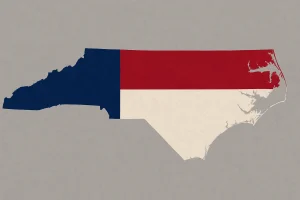
Do you believe in the Rule of Law? Talking heads from various sources bandy about Due Process, Equal Protection, and the Rule of Map outline of North Carolina filled with red, white, and blue horizontal stripes inspired by the state flag, set against a plain gray background. Law. But what do those terms really mean and are they even relevant in today’s perpetual, and frankly exhausting, messaging infrastructure?

Stripped of partisan slogans, the concept of the Rule of Law is neither vague nor ornamental. It has a precise meaning rooted in centuries of legal thought and practice.

It is not about who shouts the loudest or which faction claims the phrase; it is about the structure that makes the government accountable to the governed and liberty possible.

“They never read me my Miranda rights!” This is one of the most common statements criminal defense attorneys hear from clients who believe this oversight will automatically get their charges dismissed. Unfortunately, this widespread misconception, fueled by countless TV shows and movies, rarely reflects the reality of North Carolina criminal law.

If you’ve been arrested and are wondering about your Miranda rights, understanding when they actually apply and when they don’t could make a significant difference in your case.

If you’ve been charged with misdemeanor death by vehicle in Mooresville or felony death by vehicle in the Charlotte metro region, it’s a good idea to consult an experienced North Carolina criminal defense lawyer. The criminal defense legal team at Powers Law Firm understand the intricacies of vehicular homicide cases and may be available to serve as legal counsel and guide you through your legal options. Call or TEXT 704-342-4357 to schedule a confidential consultation.

The Rule of Law is not just a value, a tradition, or a preference. It is the operating principle of RULE-OF-LAW the United States government and the foundation upon which legal rights, public institutions, and constitutional safeguards depend.

The Rule of Law in the United States does not mean that laws are always fair. It does not mean that legal outcomes are always just.

It means that law, rather than arbitrary power, determines how authority is exercised. It means that no person is above the law.

Every year, the last Monday in May brings the hum of lawnmowers, the smell of grilled food, and the first inklings of summer. For Memorial-Day-Bob-Conroy many, Memorial Day is a chance to gather with family, enjoy a day off work, or take a short trip.

I understand that. I enjoy those things too. But for me, Memorial Day has come to mean something more, something quieter, and something harder to name. That has everything to do with my grandfather, Robert L. “Bob” Conroy.

My maternal grandfather, “Papa,” served as a medic in World War II. He was stationed in Okinawa, one of the most brutal and prolonged battles of the war.

Contact Information