 Carolina Criminal Defense & DUI Lawyer Updates
This post continues the Breath, Blood, and Bull series, an in-depth look at how science, procedure, and perception collide in the 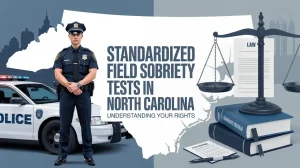 prosecution and defense of DWI cases in North Carolina. The first installment examined the limits of chemical testing. The second article turned to the machines that interpret alcohol breath samples into evidence, using the “breathalyzer.” This post focuses on the field sobriety tests or “SFSTs” that often precede BAC testing.
Standardized Field Sobriety Tests (SFSTs) are a battery of three roadside exercises: Horizontal Gaze Nystagmus (HGN), Walk-and-Turn (WAT), and One-Leg Stand (OLS), designed by NHTSA to gauge impairment.
When prosecutors rely on Standardized Field Sobriety Tests to support a DWI charge, the assumption is that these dexterity exercises offer reliable, objective proof of impairment. Yet the science tells a more complicated story.
Standardized Field Sobriety Tests (SFSTs) were validated years ago under controlled research conditions, with motivated officers, cooperative volunteers, and laboratory-style settings. The real-world roadside environment is rarely so forgiving.
Accuracy numbers cited in studies may sound impressive, but even under ideal conditions, SFSTs can produce incorrect conclusions.
After more than thirty years in North Carolina courtrooms, Bill Powers has watched the rise of roadside testing from a simple coordination check to a body of evidence that is scientific in nature. That experience includes years of teaching officers, lawyers, and legal professionals about breath testing, blood analysis, and the technical foundations of DWI investigations. He has presented and taught legal seminars focused on the scientific limitations of SFSTs to other attorneys and legal professionals. If you have questions about how SFST evidence may affect your case, or if you are trying to make sense of the science behind “drunk driving” investigations, please contact the DWI defense attorneys Powers Law Firm in Charlotte. Text or call 704-342-4357 for more information.
What Factors Can Affect Field Sobriety Test Performance?
Nervousness, medical conditions, footwear, and even the weather can affect how someone performs. That means a test designed to measure impairment can sometimes capture nothing more than human variability.
For defense attorneys, knowing how SFSTs were designed, what the research actually says about their accuracy, and where their weaknesses lie is helpful.
Challenging an officer’s conclusions about “failure” or “clue” or “cues” of impairment can turn what first looks like strong, if not apparently incontrovertible, evidence into reasonable doubt.
Future articles in this series will explore how courtroom testimony translates laboratory research into real-world practice and why genuine scientific literacy is essential for both sides of a DWI trial.
If you are facing a DUI case in North Carolina, or if you are a lawyer seeking to sharpen your defense strategies and would like some guidance, I encourage you to reach out. Call or TEXT Bill Powers at 704-342-4357 at the Powers Law Firm to discuss how preparation and scientific understanding can change the way DWI charges are defended.
Verification Studies of Standardized Field Sobriety Tests
The SFSTs were initially validated in laboratory and field studies sponsored by NHTSA in the 1970s and 1980s and updated periodically since that time.
In ideal conditions, and with cooperative test subjects, the three-test battery showed a relatively high correlation with BAC. For instance, a famous study in San Diego reported that the three tests together were 91% accurate at discriminating BAC ≥ 0.08.
HGN was found to be the strongest single indicator (roughly 77% accuracy), with Walk-and-Turn around 68% and One-Leg Stand around 65% accurate on their own.
These figures, however, come with important qualifications.
How Controlled Testing Differs from Real-World DWI Stops
The studies were conducted by researchers like Marcelline Burns under controlled conditions, often on volunteers, in well-lit areas, without the roadside distractions of real traffic stops.
Law enforcement officers administering SFSTs during some of the studies were hand-selected, highly motivated and had observers present to ensure accuracy of administration and interpretation.
As NHTSA itself acknowledges, the SFSTs are to be administered under ideal conditions, though in reality “SFSTs will not always” be conducted perfectly in the field.
Even with proper administration, the SFST battery is not infallible. By NHTSA’s own numbers, even when tests are done correctly, officers could expect about 1 in 10 subjects to be misclassified (false positive or false negative).
Independent studies have sometimes found higher false positive rates. One study found that a significant percentage of completely sober individuals could be wrongly identified as impaired based on SFST performance.
Factors such as nervousness and individual variability play a role.
Some individuals naturally have poor balance or coordination (think of those who might fall over in a yoga class stone cold sober), while others may mask impairment well.
Alcohol tolerance can also vary.
Someone with a high tolerance might perform relatively well on SFSTs even at an illegal BAC, whereas a lightweight drinker might waver with a lower BAC.
The scientific literature on SFSTs has noted these limitations. For example, a study on false positives found SFSTs could accurately distinguish above/below 0.08 in 91% of subjects, which conversely means nearly 9% of sober or below-limit subjects might nonetheless appear impaired.
DUI defense attorneys should be familiar with these studies and, where appropriate, bring them out through expert testimony or cross-examination of the arresting officer.
The goal is to show that SFSTs, while a useful law enforcement tool, are not always conclusive evidence of impairment.
Juries who initially place great weight on an officer’s testimony that “the defendant failed the field sobriety tests” may be persuaded, through methodical questioning, that what the officer observed is equally consistent with innocent causes or simply the tests’ fallibility.
Frequently Asked Questions about North Carolina Field Sobriety Tests
What do North Carolina field sobriety tests actually measure in a DWI investigation?
North Carolina field sobriety tests measure coordination, balance, divided attention, and the ability to follow instructions, but they do not directly measure alcohol concentration. The exercises were designed as roadside screening tools and are sensitive to factors unrelated to impairment, including anxiety, age, footwear, medical conditions, and lighting. Understanding what SFSTs were intended to measure and how they were validated helps you see why the results may not always reliable proof of impairment.
How accurate are standardized field sobriety tests in real North Carolina DWI stops?
Standardized field sobriety tests in North Carolina DWI stops are less accurate in real roadside conditions than they appear in controlled laboratory studies. Research sometimes cited by prosecutors reflects ideal testing environments with cooperative subjects and highly trained officers. Real stops involve traffic noise, uneven pavement, stress, and imperfect instructions. Even under ideal conditions, studies show meaningful error rates, including false positives among sober subjects.
Can someone who is sober person fail a field sobriety test during a DWI investigation?
A sober person can fail a field sobriety test during a North Carolina DWI investigation because SFST performance is influenced by far more than alcohol. Nervousness, age, weight, balance issues, joint problems, and footwear can all produce “clues” that officers interpret as signs of impairment. Independent research has documented sober participants who were thought to be “appreciably impaired” in error.
What are some common officer mistakes in administering field sobriety tests?
Common officer mistakes in administering field sobriety tests include rushing the HGN timing, giving incomplete instructions on the Walk and Turn, ending the One Leg Stand too early, or performing the tests on sloped or poorly lit surfaces. SFSTs are standardized by design, and deviations from the script or test conditions reduce (“compromise”) their validity. Comparing the video evidence to NHTSA manuals can be a key step in cross-examination and an effective defense to drunk driving charges in North Carolina.
How can a defense lawyer challenge field sobriety test evidence in a North Carolina DWI case?
A defense lawyer may be able to challenge field sobriety test evidence in a North Carolina DWI case by focusing on protocol deviations, timing errors, environmental conditions, and the scientific limits of the tests themselves. Cross-examining the officer about their training and their adherence to the NHTSA manual can also expose weaknesses and inconsistencies. Expert testimony may help jurors understand error rates, false positives, and the impact of human variability on test outcomes.
What Are the Most Common Errors in Field Sobriety Test Administration?
Common Errors in SFST Administration
It is unfortunately common for officers to make mistakes in administering or scoring SFSTs, mistakes that can provide helpful material for the defense. By design, SFSTs are standardized. The instructions, clues, and scoring criteria are set by NHTSA and taught in police academies. Any significant deviation from these standards can invalidate the test’s results.
Here are some common errors and how they might be used in defense strategy in appropriate circumstances:
- Improper Instructions or Demonstration: If the officer doesn’t properly explain or demonstrate the test, the suspect’s performance may reflect confusion rather than impairment. For example, failing to tell the suspect to watch their feet during OLS, or not explaining the correct turn in the WAT, can lead to mistakes by the suspect that are not actually due to impairment. Cross-examining the officer on exactly what instructions were given (versus what the manual prescribes) can reveal discrepancies. If the stop was recorded on dash-cam or body-cam, compare the officer’s actual instructions to the NHTSA scripted instructions. Divergence from the test protocols may be highlighted in appropriate circumstances to the jury or possibly used in a motion in limine to limit the officer’s conclusions about the test.
- Non-Standardized Test Conditions: The manual states SFSTs should ideally be done on a level, dry, well-lit surface with minimal distractions. Unfortunately, many DUI stops occur roadside at night, on uneven gravel shoulders or slopes, with traffic whizzing by and lights flashing. These conditions can cause anyone to perform poorly. Officers might push forward with SFSTs despite rain, high winds, or a suspect’s complaints of an injury. Documenting these conditions (through police reports, videos, or witness testimony) may allow the defense to argue that the SFST results are compromised. For instance, if the police report fails to note the test was done on an incline, the defense could point out that maintaining heel-to-toe on a slope is not appropriate and noncompliant with testing protocols, thereby compromising the accuracy of test results.
- Timing and Pacing Errors: SFST protocols include specific timing (e.g., HGN requires a certain pace when moving the stimulus; OLS should last 30 seconds). Officers under stress may rush through HGN, moving the stimulus too quickly, which can induce nystagmus or cause the officer to miss subtle clues. They might also terminate the OLS or WAT too soon, not giving the suspect enough time to comply fully. On cross, ask the officer to detail how long they held the stimulus at maximum deviation during HGN (it should be a minimum number of seconds). If they don’t know or the timing isn’t long enough, that could be a breach of protocol that undermines the test’s validity. Similarly, ask if they had a stopwatch for the OLS or were just estimating 30 seconds.
- Scoring and Subjectivity: While SFST clues are objectively defined on paper, in practice, there is subjectivity in recognizing them. What one officer calls “swaying” might be, to another observer, perfectly normal slight movements. Officers may also fail to affirmatively disclose if a suspect performed parts of the test well. For example, if a suspect wobbled on step 1 of the WAT but then did the next 8 steps flawlessly, some officers will focus only on the wobble as a clue of failure. Defense counsel can ask the officer to acknowledge everything the suspect did correctly (e.g., “He kept his balance during instructions, correct? He didn’t use his arms until the very last step, correct?”) to counterbalance the portrayal of “failure.” Another angle is whether the officer combined tests or improperly instructed additional, non-standard tests (like finger-to-nose or alphabet recitation). Non-standard tests are not NHTSA-validated and should not carry the same weight; if the officer relied on them, that’s a point of attack (possibly moving to exclude those portions entirely as lacking scientific basis).
Challenging SFST evidence requires comparing what actually occurred in the field with what the science-based standards prescribe.
By highlighting deviations and uncertainties, a defense attorney may argue that the SFSTs in a given case prove little about actual impairment. Some judges have even suppressed or limited SFST evidence when the deviation from protocol is egregious.
More commonly, this line of attack will be used before the jury to diminish the credibility of the officer’s conclusion that the defendant was impaired, barring other evidence such as BAC results.
An expert witness on SFSTs, police procedures, and human performance can bolster this strategy, testifying that even small mistakes in SFST administration significantly reduce the tests’ accuracy.
The takeaway is that SFSTs are not magic. They are coordination exercises with known error rates, and the defense’s job is to pull back the curtain on their limitations.
How Can Defense Lawyers Challenge Field Sobriety Test Evidence?
During the trial, cross-examination can be an important weapon to attack SFST evidence.
A thorough cross of the arresting officer might cover the officer’s training (when and where they received training, and whether they kept up with refresher courses per the recommendations of the NHTSA training materials), the circumstances of the test (lighting, weather, ground conditions), the exact instructions given, whether demonstrations were done, and each clue the officer claims to have observed.
A methodical approach can turn an initially damaging-sounding testimony into a far murkier picture where perhaps only one or two minor deviations occurred under difficult conditions.
Be prepared. Know the SFST standards better than the officer, and use video to hold the testimony accountable to the facts.
Do Expert Witnesses Make a Difference in SFST Cases?
In addition to crossing the officer, expert testimony can be extremely effective. A defense-retained expert (such as a former police instructor or a scientist specializing in psychometrics) may be able to testify about the limitations of field sobriety tests.
An expert might explain that even a 91% accuracy rate means nearly 1 in 10 results could be wrong or that the original validation studies had exclusion criteria (e.g., they didn’t include people over a certain age or with certain medical conditions).
The expert could also discuss how anxiety and officer cues might affect a suspect’s performance.
When the jurors hear a knowledgeable expert concede that sober people can and do exhibit some SFST clues (and conversely, some drunk people can occasionally mask them), could plant seeds for reasonable doubt.
Why Field Sobriety Test Evidence Is Not Always Conclusive
The overall defense strategy is to convert SFST evidence from a prosecution strength into a potential liability.
It would be optimal for the juror to view SFSTs not as a clear indicator of guilt but as an imperfect diagnostic tool potentially fraught with uncertainty.
If that goal is achieved, the prosecution’s heavy dependence on SFST performance (especially in cases involving a willful refusal and/or questionable BAC evidence) can boomerang, reinforcing the defense theme of reasonable doubt.
Talk with a North Carolina DWI Defense Lawyer about SFST Evidence
Understanding how field sobriety tests are designed, administered, and interpreted can make the difference between conviction and reasonable doubt. The next article in the Breath, Blood, and Bull series explores how evidentiary breath testing devices actually work, from infrared spectroscopy to fuel cell oxidation, and why understanding their scientific foundations can be as important as knowing how to cross-examine a field sobriety test. You can read it here: Breath, Blood, and Bull: How the Breathalyzer Works. If you are facing a DWI charge in North Carolina or you are a defense lawyer seeking deeper insight into SFST science and cross-examination techniques, contact the Powers Law Firm in Charlotte. Call or text Bill Powers at 704-342-4357 to discuss how preparation and scientific accuracy can shape the outcome of a DWI case.