 Carolina Criminal Defense & DUI Lawyer Updates
You may not expect prescription medication to expose you to DUI charges. Yet in North Carolina, impairment rather than the legality of the substance or intent to break the law triggers criminal charges. If a prescribed medication impairs your ability to drive, you can be prosecuted under state law. That surprises some folks, who mistakenly believe following “doctor’s orders” and driving is OK.
How North Carolina Defines Prescription Medication DUI
Under N.C. Gen. Stat. § 20-138.1, someone commits the offense of impaired driving if they operate a vehicle while with a blood alcohol concentration of 0.08 or more or under the influence of an impairing substance, even if the substance is prescribed. The statute essentially bars the defense that a drug was legally prescribed if taking the medication adversely affects your mental or physical faculties to such extent there is a noticeable or appreciable impairment.
The definition of “impairing substance” under § 20-4.01(14a) includes any drug capable of impairing your faculties, regardless of whether a prescription authorizes it.
This statutory structure means that the law does not distinguish between alcohol, illegal drugs, or medication obtained from your pharmacy with a valid prescription.
The focus is on whether you were appreciably impaired at the time you were driving. Appreciable impairment means that your mental or physical faculties were noticeably affected, even if the change was subtle.
You need not be “stoned” or “drunk” or “high” to be convicted.
Why Prescription Medication DUI Law Matters in North Carolina
The key concern is whether your driving was impaired, not whether the drug was legally prescribed.
In North Carolina, there is no numeric per se level for prescription medications. That said, N.C.G.S. 20-138.1(a)(3) makes it unlawful to drive with any amount of a Schedule I controlled substance or its metabolites in your system.
Any noticeable impairment can support a DUI charge, even if you followed your doctor’s instructions.
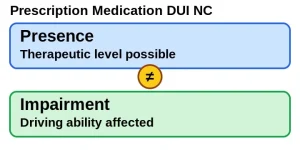
This makes prescription drug cases uniquely challenging for both the defense and prosecution, as the presence of the drug alone is not enough and the state must prove impairment.
Prosecutors sometimes rely on officer observations, video evidence, and roadside testing to build their case.
DWI defense attorneys anticipate the different types of evidence that may be presented, because the fact that you had a lawful prescription will not, by itself, prevent a conviction.
Understanding Field Sobriety and Chemical Evidence
Law enforcement often builds its case through driving behavior, field sobriety performance, and sometimes chemical tests. That’s consistent with the NHTSA – National Highway Traffic Safety Administration “Phase I, Phase II, and Phase III” detection process.
If you have questions about SFSTs (Standardized Field Sobriety Tests) and how officers in North Carolina are trained to detect impairment consistent with NHTSA protocols, check out our North Carolina DWI Quick Reference Guide.
Even if a blood analysis shows therapeutic levels, officer observations of confusion, slowed reactions, or difficulty following instructions can persuade a prosecutor.
The state may call a Drug Recognition Expert, sometimes referred to as a DRE, or rely on officer testimony to establish impairment. Learn more about North Carolina DRE evidence here.
Standardized Field Sobriety Tests, or “sobriety tests,” were designed primarily to detect alcohol impairment, not the effects of prescription drugs.
-
Standardized Field Sobriety Tests (SFSTs) — the Horizontal Gaze Nystagmus, Walk-and-Turn, and One-Leg Stand, were validated by the National Highway Traffic Safety Administration (NHTSA) specifically for detecting a blood alcohol concentration of 0.08 or more.
-
They were not designed or validated to measure impairment from prescription or other drugs.
-
Because medications can cause different physical or cognitive effects than alcohol (for example, drowsiness without balance issues, or delayed reactions without nystagmus), SFST results in prescription drug cases may be less reliable indicators of actual impairment.
This can make them less reliable in medication-related DWI charges.
Nonetheless, officers often use them in drug-impaired driving investigations, and the results can easily be misinterpreted.
A defense strategy may involve showing how the side effects of lawful medication differ from the signs of impairment the officer claimed to see.
Chemical evidence in prescription medication DUI cases often comes from blood draws analyzed for specific drug levels.
The presence of a drug does not automatically mean impairment, especially when levels fall within a therapeutic range.
However, there may be a legitimate argument presented in court that even therapeutic levels can impair certain drivers, making toxicology interpretation a key point in the defense.
North Carolina Case Law on Prescription Medication DUI
In North Carolina v. Highsmith, 173 N.C. App. 600 (2005), the Court of Appeals upheld a conviction where the driver had taken legally prescribed medication but exhibited impaired coordination and slow speech. The court emphasized that lawful possession of a prescription does not excuse impairment under § 20-138.1. Erratic driving, sluggish movements, slurred speech, the admission to taking a potentially impairing prescription medication, and expert testimony explaining the medication’s effects can be enough.
In North Carolina v. Eldred, 259 N.C. App. 345 (2018), the case turned on an essential element of the DWI offense under N.C. Gen. Stat. § 20‑138.1, that being whether the defendant was impaired while driving. The appellate court reviewed whether the State presented “substantial evidence” of that element and of Eldred being the driver. The standard at the dismissal stage requires taking all evidence in the light most favorable to the State and drawing every reasonable inference in its favor.
The court reversed the denial of Eldred’s motion to dismiss. It held that speculation or conjecture cannot support a conviction. The absence of both direct and sufficient circumstantial evidence meant the State failed to establish an essential prima facie element of the offense, operation. The case lacked key data timing of contact, substance consumption timeline, and objective proof of impairment.
These cases highlight that the central question for the court is whether your ability to operate a vehicle was appreciably impaired, not the source or legality of the substance in your system.
Why Individual Variability Affects DUI Cases
Your metabolism, age, weight, liver and kidney health, and co-medications can significantly shape how a drug affects you.
A dose that is safe for one driver may be impairing for another.
Fatigue, dehydration, and interactions with over-the-counter products can intensify the effects of medication.
Because these variables differ from one defendant to another, forensic toxicology experts can play an important role in court.
They can explain how certain medications affect reaction time, coordination, and cognitive function, and why two drivers with identical blood concentrations might perform very differently behind the wheel.
Defense Approaches in Prescription Medication DUI Cases
Defending these cases requires careful review of both the legal process and the scientific evidence. Important areas of focus include:
- Traffic stop: Whether the officer had reasonable suspicion to initiate the stop.
- Field sobriety testing: Whether the sobriety tests were administered correctly and whether the results were interpreted accurately.
- Chemical testing: Whether the blood sample was collected, stored, and analyzed according to accepted protocols.
- Medical documentation: Whether records support that you took the medication as prescribed.
- Expert testimony: Whether a toxicologist can explain the difference between presence and impairment, as well as individual metabolic differences.
An effective defense may focus on whether the prosecution’s expert is qualified to interpret drug levels and whether the state’s testing method can reliably detect impairment rather than mere presence.
Practical Steps if You Are Charged
If you face a prescription medication DUI in North Carolina or what some people call “drugged driving,” acting quickly is important. Steps you should consider include:
- Gathering your prescription records, dosage instructions, and physician testimony.
- Obtaining medical records that document lawful and therapeutic use of medication.
- Consulting an experienced prescription medication DUI defense lawyer.
- Retaining a qualified toxicologist early to evaluate impairment risks.
Prompt action allows your defense team to preserve evidence, consult experts, and identify weaknesses in the prosecution’s case before they become difficult to challenge.
If you have been charged, call Powers Law Firm at 704-342-4357 or find us on Google Maps to discuss your case confidentially.
Defending Prescription Medication DUI and “Drugged Driving” Cases in North Carolina
Powers Law Firm represents people facing prescription medication DUI and “drugged driving” charges throughout Mecklenburg, Union, Iredell, Gaston, Lincoln, and Rowan Counties. The firm also defends, on a statewide basis, select felony-level DWI-related allegations, including Felony Death by Vehicle and Felony Serious Injury by Vehicle. Each case begins with a detailed review of the facts and applicable law, incorporating scientific and technical analysis when it can help build a defense.
About Bill Powers
Bill Powers is widely regarded for his work in impaired driving defense throughout North Carolina. His teaching includes regular instruction at the Charlotte-Mecklenburg Police Training Academy, chairing the 2025 North Carolina Advocates for Justice Criminal Masters of Advocacy. Since 2014, he has served on the Governor’s Statewide Impaired Driving Task Force following his initial appointment by Governor Pat McCrory.
Over the course of his career, Bill has been recognized in Super Lawyers® North Carolina Magazine as one of the “Top 100” lawyers in North Carolina and among the “Top 25” in Charlotte in 2025. Bill Powers has been included in Best Lawyers in America® for 2025, and Powers Law Firm PA has been honored in Best Law Firms in America® in the same year (2025). In 2020, the North Carolina State Bar recognized him with the John B. McMillan Distinguished Service Award for his professional service and contributions to the legal community. To obtain more information about the selection and inclusion processes for these recognitions, visit the Super Lawyers® North Carolina Magazine Selection Process and the Purely Peer Review® Methodology and Process for Best Lawyers in America® and Best Law Firms in America®.